Packaging Inspection System: Automated Visual Inspection on the Line
A packaging inspection system is a camera-based, automated visual inspection that checks every pack on the line and removes faulty ones. It is built for production and quality managers who want consistent, documented results instead of manual checks. Visioline Infra OÜ adds it to your existing line, so you do not need a new one.
What a packaging inspection vision system does
A camera photographs every pack and an AI model decides in under 100 milliseconds whether it is good (OK) or faulty (NOK). Faulty packs are pushed off the line, and the image of every pack is kept.
The decision can also have three levels: OK, WARN and NOK. WARN marks a borderline case for an operator to review. On well-defined tasks, typical accuracy is over 99%.
What exactly is checked is agreed for your product and pack. A vision-language model (VLM) can be instructed in plain words and describes what is wrong with a pack. Often it works without any training. If training is needed, you need at least a few hundred images; several thousand is optimal.
Cameras and lighting are chosen for the pack: Basler and other industrial cameras, IP67-rated where needed, and custom LED, dome or backlighting. Processing runs on site on an NVIDIA Jetson device or an industrial server, so images and results stay inside your company.
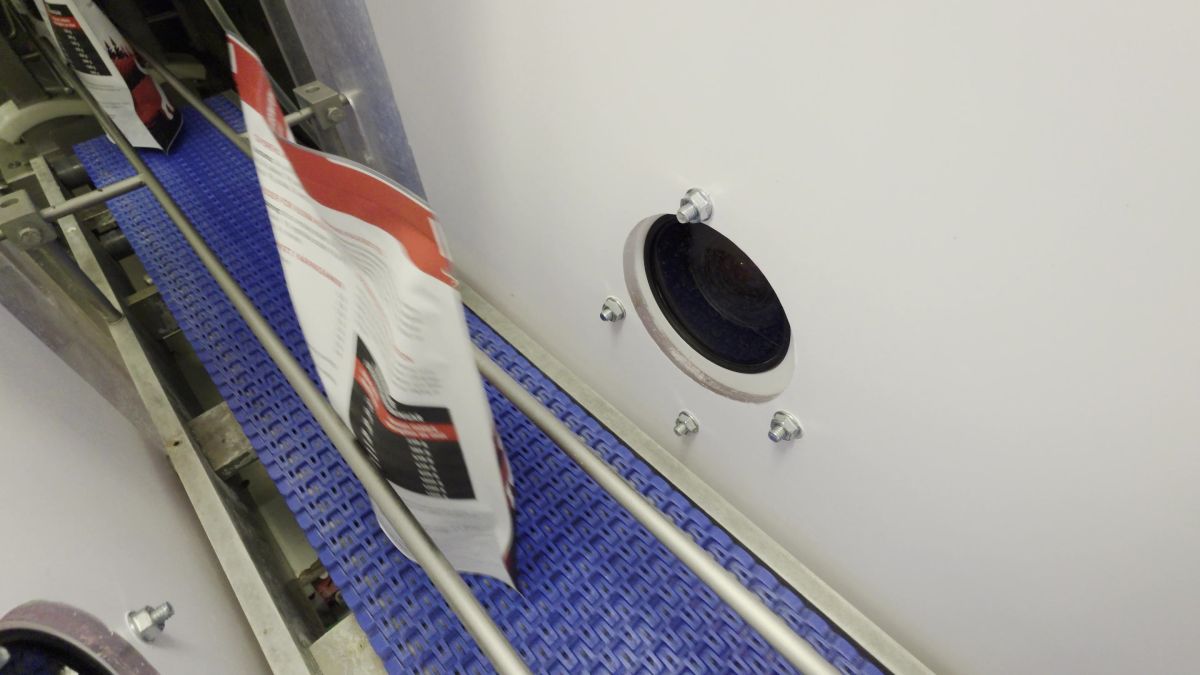
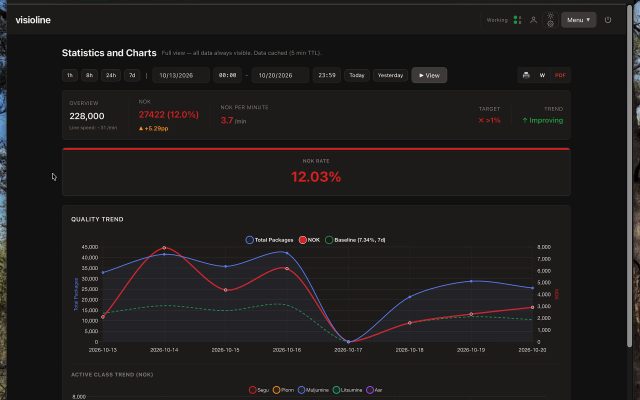
How it works: an example from a pet-food packaging line
One system Visioline built runs on a pet-food packaging line. The same line appears in our demo videos. It works in four steps:
- Packing. Packs leave the packaging machine one by one.
- Camera inspection. Visioline cameras A and B photograph every pack through a tunnel window, and the model marks it OK or NOK.
- Weighing and metal detection. A Nemesis checkweigher weighs each pack and detects metal.
- Rejection. The rejector pushes faulty packs into a reject bin. An operator checks them, or they are sorted automatically.
The camera inspection connects to the existing checkweigher, metal detector and rejector. It talks to the PLC via HTTP POST, Modbus or OPC-UA.
What the quality manager sees
The quality manager can follow the line live and look back at any period. The view shows:
- a live feed of every pack with its OK/NOK result;
- statistics by hour, shift and day: reject rate and defect types;
- a production monitor screen for the shop floor;
- an AI interpretation in plain language;
- the live camera image.
Because every pack is photographed, you can show exactly what left the line when a customer complains or an auditor asks. The statistics show when the packaging machine starts making defects, so the cause can be fixed. See the system at work in the VisiolineLT demo videos.
The data can also go to the systems you already use: SCADA (Ignition, Siemens WinCC), ERP and MES (SAP, Microsoft Dynamics), and reporting in Power BI or Grafana. Reports export to CSV or PDF.
What it can do for your production
Results depend on the process, but for example:
- scrap can drop by 50–90%;
- customer complaints can drop by 40–70%;
- inspection labour cost can drop by 60–80%, because one camera system can replace 2–5 manual inspectors;
- line speed can increase by 20–40%.
Typical payback is about one year. We explain the costs in more detail on the machine vision system cost page.
What you need to start
To start, a description of the line and samples of good and faulty packs are enough. You do not need a new line.
- Line details: speed, pack type and existing equipment, such as a checkweigher, metal detector and rejector.
- Cameras: existing cameras can often be reused. If needed, we choose industrial cameras and lighting for the task.
- Images: if the model needs training, at least a few hundred images of good and faulty packs.
The project runs in phases: project plan, design, development, testing and a pilot on the line, launch and training, then ongoing support. From the first meeting to full deployment typically takes 1–3 months. The pre-sales consultation is free. Visioline Infra OÜ works in Estonia and, on request, elsewhere in Europe and in the USA.
Frequently asked questions
Yes. The camera system is installed on your existing line and connected to the equipment already there, such as the checkweigher, metal detector and rejector. It talks to the PLC via HTTP POST, Modbus or OPC-UA. Existing cameras can often be reused too. The exact setup depends on the line and is agreed in the project plan.
The OK/NOK decision takes under 100 milliseconds. For fast lines there is CleanView, an all-in-one device that supports up to 6 cameras, 8K resolution and up to 240 frames per second, with AI processing on the device. Which hardware suits your line depends on line speed and how small the defects are.
Yes. Every pack is photographed and its result is saved. VisiolineLT shows statistics by hour, shift and day, and reports can be exported as CSV or PDF. So when a customer complains or an auditor asks, you can show what left the line. With an on-site setup, production data stays inside your company.
Yes. For smaller lines there is a starter pack: one camera, basic detection models in ONNX format, a simple web interface and quick installation. You pay in monthly instalments over one year. Whether the starter pack fits your line or you need a multi-camera system is something we work out in the free consultation.
Other solutions
- AI Visual Inspection for Defect Detection in ManufacturingLearn more →
- Machine Vision Measurement: Inline Dimensional InspectionLearn more →
- Vision Counting System and Machine Vision SortingLearn more →
- AI Safety Camera: People and Forklift Detection in Hazardous ZonesLearn more →
- Machine Vision System Cost: What Drives the PriceLearn more →
Let's talk about your line
The pre-sales consultation is free. Tell us what you want to detect – we will assess whether and how it works on your line.